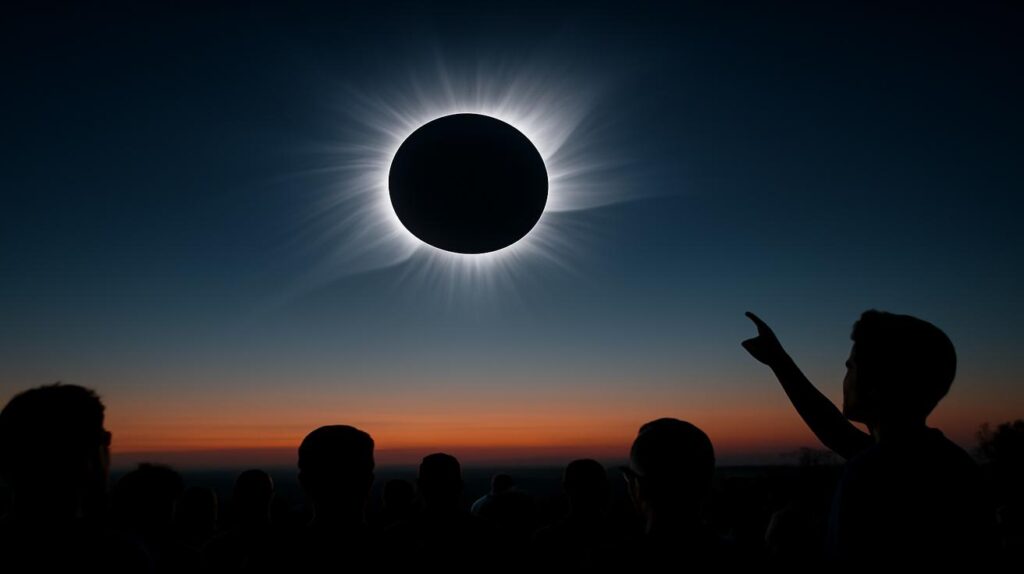

Astronomy enthusiasts and sky watchers around the world are already preparing for one of the most remarkable celestial events of the century. Scientists have confirmed that an exceptionally long total solar eclipse will occur in the coming years, an event so dramatic that daylight will temporarily transform into darkness for an unusually extended period.
Solar eclipses occur when the Moon moves precisely between the Earth and the Sun, blocking sunlight and casting a shadow across parts of the planet. While eclipses happen several times every decade, very long total eclipses are extremely rare. The one scheduled in the coming years is expected to stand out because of its remarkable duration.
For millions of observers positioned within the eclipse path, the event will create an unforgettable astronomical spectacle.
What Makes This Solar Eclipse So Extraordinary
Most total solar eclipses last only a few minutes. The Moon’s shadow moves rapidly across the Earth’s surface, meaning the period of complete darkness is usually brief.
However, certain rare alignments allow the Moon to cover the Sun for much longer. During this upcoming event, the geometry of the Earth, Moon, and Sun will create one of the longest periods of totality expected in the entire century.
Astronomers explain that the precise distance of the Moon from Earth and the position of the eclipse path across the planet will contribute to the unusually long duration.
Key Details About the Longest Eclipse Event
| Feature | Expected Detail |
|---|---|
| Type of event | Total solar eclipse |
| Maximum duration | About 7 minutes and 29 seconds |
| Expected date | July 16, 2186 |
| Visibility | Parts of South America and the Atlantic region |
| Rarity | Longest total eclipse of the 21st and 22nd centuries |
This duration is remarkable because most eclipses provide only two to four minutes of total darkness.
What People Will Experience During Totality
During a total solar eclipse, the Moon completely blocks the Sun’s bright disk, revealing the Sun’s outer atmosphere known as the corona. As daylight disappears, the sky darkens rapidly and temperatures may drop slightly.
Animals often react as if night has suddenly arrived. Birds may stop singing, and nocturnal animals can become active.
Observers within the path of totality will witness the sky turning deep twilight while stars and planets briefly become visible in the middle of the day.
Why Such Long Eclipses Are Extremely Rare
Several astronomical conditions must align perfectly for a long total eclipse to occur. The Moon must appear slightly larger in the sky than the Sun, which happens when the Moon is closer to Earth in its orbit.
At the same time, the Earth must be positioned at a point in its orbit where the Sun appears slightly smaller. This combination allows the Moon to cover the Sun completely for a longer period.
The path of the Moon’s shadow also plays a crucial role. When the shadow crosses regions where Earth’s rotation slows the shadow’s movement relative to the ground, totality lasts longer.
Why Astronomers Consider This a Historic Event
Long duration eclipses provide scientists with valuable opportunities to study the Sun’s corona, magnetic activity, and solar atmosphere. During totality, instruments can observe details that are normally hidden by the Sun’s intense brightness.
For astronomers, these rare events offer extended observation time, making them particularly valuable for research.
Even though the eclipse will occur far in the future, it has already been calculated with remarkable accuracy thanks to precise orbital models used by astronomers.
Conclusion:
The upcoming longest solar eclipse of the century promises to be one of the most extraordinary astronomical events ever predicted. With a duration approaching seven and a half minutes, the eclipse will transform daylight into twilight for an unusually long period.
Although the event is scheduled far in the future, it highlights the fascinating precision with which scientists can predict celestial phenomena. When the moment finally arrives, it will offer a breathtaking reminder of the cosmic mechanics that shape our solar system.
Disclaimer:
Astronomical predictions are based on current orbital calculations and scientific models. Visibility and precise timing may vary slightly depending on geographic location and atmospheric conditions.